Multica: Turning AI Agents into Real Teammates
Multica is an open-source, multi-human and multi-Agent collaboration platform that supports Claude Code and Codex. It transforms Agents from passive tools into active participants, enabling them to work like human colleagues: receive tasks, report progress, create issues, and proactively signal blockers. The platform also features a Skill mechanism, allowing solutions to be codified into reusable capabilities for the entire team. The code is open source.
Last week, Jiayuan (JY) Zhang launched a product called Multica.
In simple terms, it's a platform that enables multiple humans and multiple AI Agents to collaborate together.
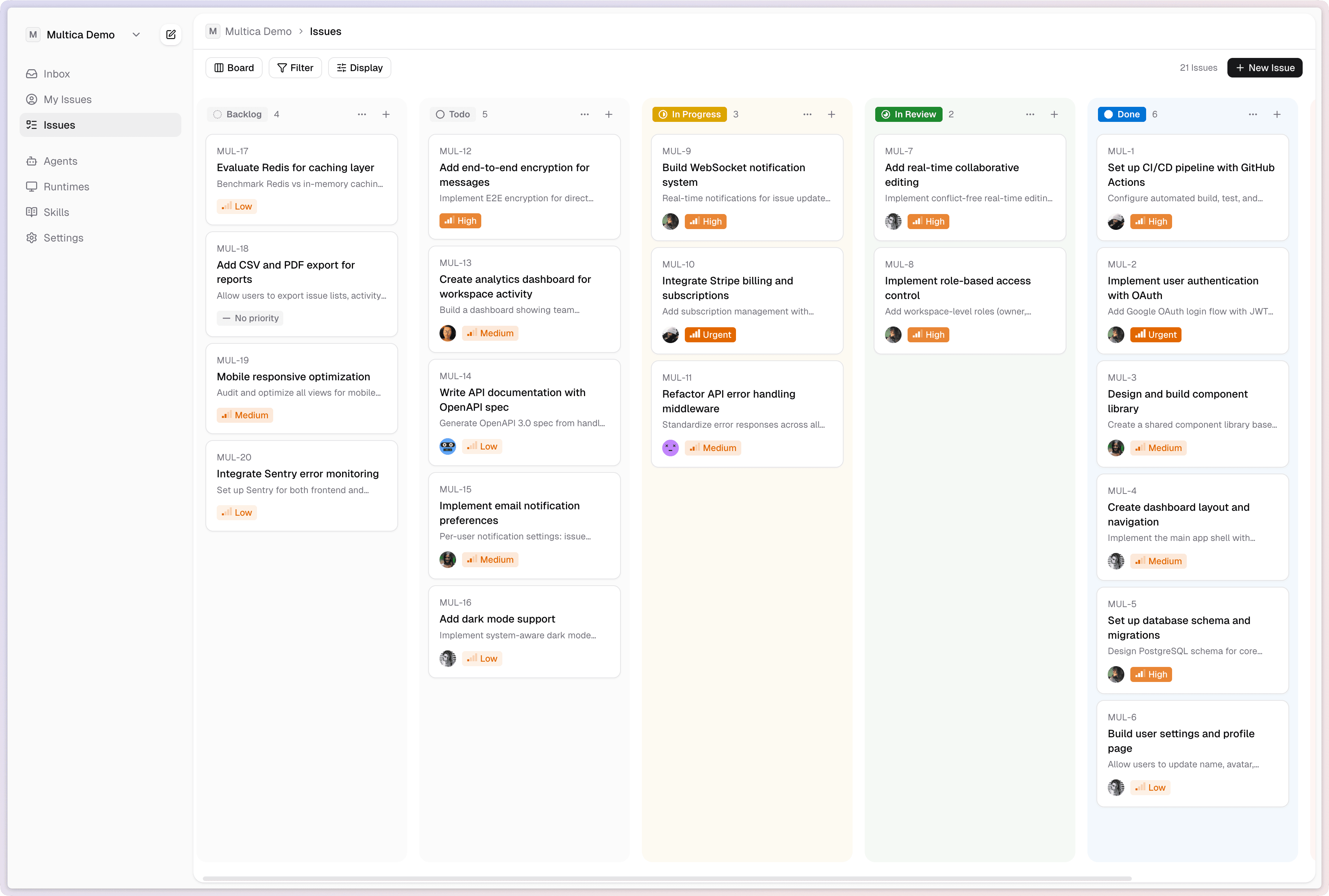
The core concept is straightforward: the traditional approach treats Agents as tools—feed them a prompt and wait for a result. Multica believes this is a waste of potential—Agents can act more like real team members.
It has several key design features:
**1. Agents Get Treated Like Human Colleagues**
In Multica, Agents appear alongside humans in the same assignee dropdown menu. You can assign an issue to an Agent, which will then pick up the task, write code, update its status, comment, and proactively raise any blockers it encounters. The entire process is indistinguishable from assigning the task to a human colleague.
**2. Tasks Have a Full Lifecycle**
It's not just simple prompt-response. Tasks go through a complete workflow: enqueue → claim → start → complete/fail. Each status change is pushed in real-time, so you always know what an Agent is working on.
**3. Skill Mechanism: Codifying Capabilities**
This is the part I find most interesting. You can write a "Skill"—essentially packaging a specific solution into a reusable capability definition. Examples include "Deploy to staging," "Write migration," or "Review PR." Write it once, and all the Agents on your team can use it.
Day 1, you teach one Agent how to deploy. By Day 30, all your Agents can deploy. Team capabilities grow multiplicatively.
**4. Unified Runtime Dashboard**
Local daemons and cloud runtimes are managed from a single dashboard. It automatically detects if Claude Code or Codex are available on the machine. You get a clear, real-time view of which Agents are running and which machines are online.

The tech stack is clear:
- Frontend: Next.js 16
- Backend: Go (Chi + WebSocket)
- Database: PostgreSQL + pgvector
- Agent Runtime: Invokes Claude Code or Codex via a local daemon
It's open source, with code on GitHub. You can use the cloud version directly or opt for self-hosting.
---
A 20-minute demo video is available here:
In the video, Jiayuan demonstrates using Multica to develop Multica itself—pretty much taking the tool's practice to the max.
---
A few replies are worth noting:
@lucas mentioned it resembles Cline's kanban project. Jiayuan responded that Multica is more than just a kanban tool; it's a multi-human, multi-Agent collaboration platform.
@金泓 asked if there is a Chinese interface. Jiayuan said an English version will likely be released first.
@黄新 suggested that beyond development, user growth and community management are directions they want to explore—which is indeed an interesting avenue.
---
**Official Website**: https://multica.ai
**GitHub**: https://github.com/multica-ai/multica
If you're interested, give it a try. See what collaboration looks like when Agents are treated as full-fledged team members.
发布时间: 2026-04-07 17:35